


Free written scope consultation - allowances, timeline, and change-order rules on paper before a single trade is scheduled
Plant Prefab Home Additions & ADU: The Austin Owner’s Guide
Adding square footage to a Plant Prefab home in Austin typically runs $45,000 – $130,000 for a stick-built addition, while a full ADU on your lot runs $90,000 – $220,000 depending on size, site prep, and finish level. Most owners call us because their Plant Prefab panel system isn’t integrating cleanly with conventional framing, or the roof-to-panel transition has developed a leak near the chase. You’ll usually notice it as a water stain at the seam where the addition ties in, or a gap that opens and closes with Austin’s freeze-thaw cycles and our summer heat dome expansion.
We’re an independent contractor, not affiliated with Plant Prefab, but we work with their panel systems regularly across Austin. Luca Romano has been matching conventional framing to prefab wall and roof panels for years now. The fix usually comes down to correct flashing detail, proper expansion allowance, and knowing which fasteners grab the embedded steel in those panels.
Key Takeaways:
- Installed home addition pricing in Austin: $45,000 – $130,000
- ADU construction runs $90,000 – $220,000 on your lot
- We match Plant Prefab panel specs to conventional framing without voiding your original envelope warranty
- Written price before work starts, per The Relay Visibility Guarantee
Which Plant Prefab Models This Applies To

Plant Prefab builds several panelized series, and the compatibility question depends on which generation your home came from. Older Plant Prefab modules used a 2×6 wood frame with OSB sheathing and a specific weather-resistive barrier (WRB) at the panel edges. Newer builds spec a denser panel core with engineered steel connectors at the chase corners. The gotcha: if your addition framing is standard 2×4 and your Plant Prefab panels are 2×6 with an inset shear panel, you’ll get a 2-inch step at the wall junction that nobody notices until drywall goes up and the corner looks bowed.
Here’s what we check before writing a number: panel thickness at the tie-in point, whether the existing WRB overlaps cleanly or was cut flush at the factory (common on early Austin installs), and whether the roof is a modular truss or a panelized SIP. For Plant Prefab specifically, we spec a compatible WRB and flashing system rather than whatever the lumberyard has on the shelf. Cheaper aftermarket flashing tape off-gasses in Austin’s August heat and peels within two seasons. We use manufacturer-spec materials, not mystery substitutes.
Styles & brands we work with







Signs Your Plant Prefab Home Additions & ADU Is Failing
- Water staining at the ceiling-to-panel seam. This almost always traces to a failed flashing detail where the addition roof ties into the original Plant Prefab panel edge. Austin’s heavy spring downpours find that seam fast.
- A visible gap that widens in winter and tightens in summer. Panel systems expand and contract differently than stick framing. If the original connection didn’t allow for movement, you’ll see the joint open up every January.
- Doors or windows in the addition that stick or won’t latch square. Means the foundation tie-in has shifted, or the panel-to-framing connection wasn’t aligned on the correct plane before fastening.
- Drywall cracks running diagonally from the tie-in corner. Classic sign of differential movement between the Plant Prefab module and the conventional addition. Patching won’t hold until the connection is corrected.
- Higher cooling bills after the addition was built. If the building envelope at the seam wasn’t sealed, conditioned air is escaping at the junction, and your HVAC has been working overtime ever since.
See the difference
 Before
 After
After Before
 After
After Before
 After
AfterReplacement Cost & What’s Included
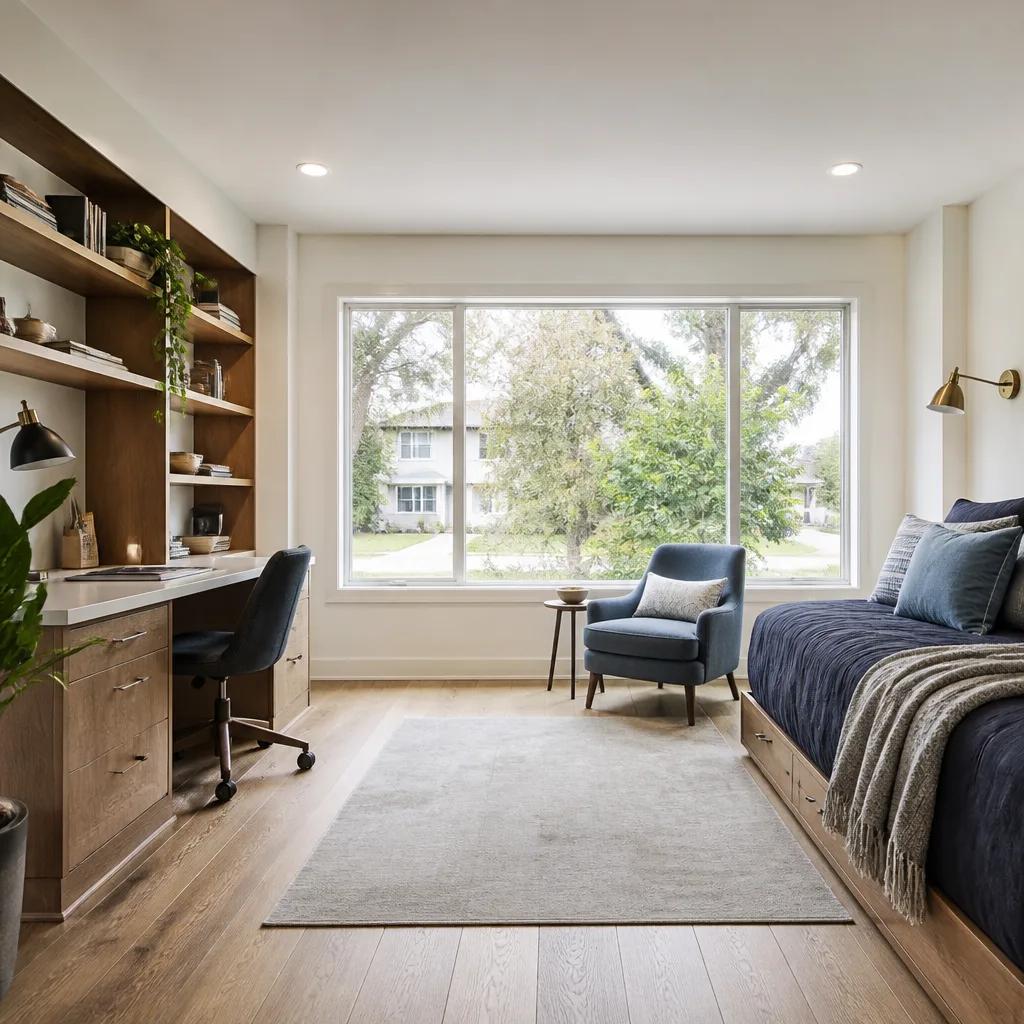
Here’s the honest math for Austin. A straightforward single-room addition on a slab foundation typically lands between $45,000 and $75,000. Larger multi-room additions, second-story work, or anything with a kitchen or bath in the new space pushes you toward the $90,000 – $130,000 range. A detached ADU with its own foundation, utilities, and finishes runs $90,000 at the low end and up to $220,000 for a two-bedroom build with a full kitchen.
| Project Type | Austin Installed Range |
|---|---|
| Single-room addition (slab) | $45,000 – $75,000 |
| Multi-room addition with bath/kitchen | $90,000 – $130,000 |
| Garage conversion to living space | $30,000 – $80,000 |
| Detached ADU (studio – 2 bed) | $90,000 – $220,000 |
Every line item is written down before we start: framing, tie-in flashing, electrical rough-in, drywall, trim, and finish. You approve the number, and that’s the number on the invoice. No change orders at the door. The work carries our 365-Day Done Right Promise: if something’s not right within a year, we come back and fix it.
DIY or Call Us?
You can inspect the seam. Get on a ladder and look at the flashing where the addition meets the original Plant Prefab panel. If you see cracked tape, lifted flashing, or daylight through the joint, that’s your problem. You can also run a hose on the roof during a dry day and watch for water inside. Those checks are safe and free.
What you shouldn’t do is pull flashing and re-tape it yourself. Plant Prefab panels use a specific WRB and fastening pattern. Wrong tape or a missed lap means water gets behind the panel in six months, and now you’re paying for mold remediation on top of the original fix. This is framing, waterproofing, and structural tie-in work all at once. If you want a real look at what we’d charge, call (409) 834-4854 and we’ll schedule a free estimate.
FAQs

A properly tied-in addition matches the lifespan of the original structure, typically 40 – 60 years for the framing, but the failure point in Austin is almost always the seam flashing, not the structure itself. Austin’s summer heat and spring storms beat on that junction. Expect flashing replacements every 10 – 15 years. Call (409) 834-4854 and we’ll inspect yours for free.
In most cases, yes. If the framing is sound and the movement is within tolerance, we re-flash the seam, add the proper expansion joint, and repair the cosmetic damage. Full rebuilds are rare. Call (409) 834-4854 and we’ll tell you which one you’re looking at after a site visit.
Depends on scope. A single-room addition runs 8 – 12 weeks typical. A full ADU runs 4 – 7 months, including permits and foundation. We track everything through The Relay Standard: live arrival times, photo updates, and a written schedule before we start. Call (409) 834-4854 for a timeline specific to your lot.
We stock the standard flashing profiles, WRB rolls, and fasteners on our trucks for most Plant Prefab panel generations. Specialty connectors and panel-specific hardware we order direct from the supplier, usually 3 – 5 business days in Austin. Call (409) 834-4854 and we’ll confirm what’s needed for your model.
If your Plant Prefab home needs an addition, an ADU, or a fix at the seam where an old addition ties in, call (409) 834-4854. We’ll walk the site, write the price down, and you’ll know exactly what you’re paying before anything gets cut. Measure twice, cut once – then we actually build the thing.
Written by Luca Romano, Owner, Sawyer Remodel Austin at Sawyer Remodel Austin, serving Austin and nearby areas.


